Challenges & Themes
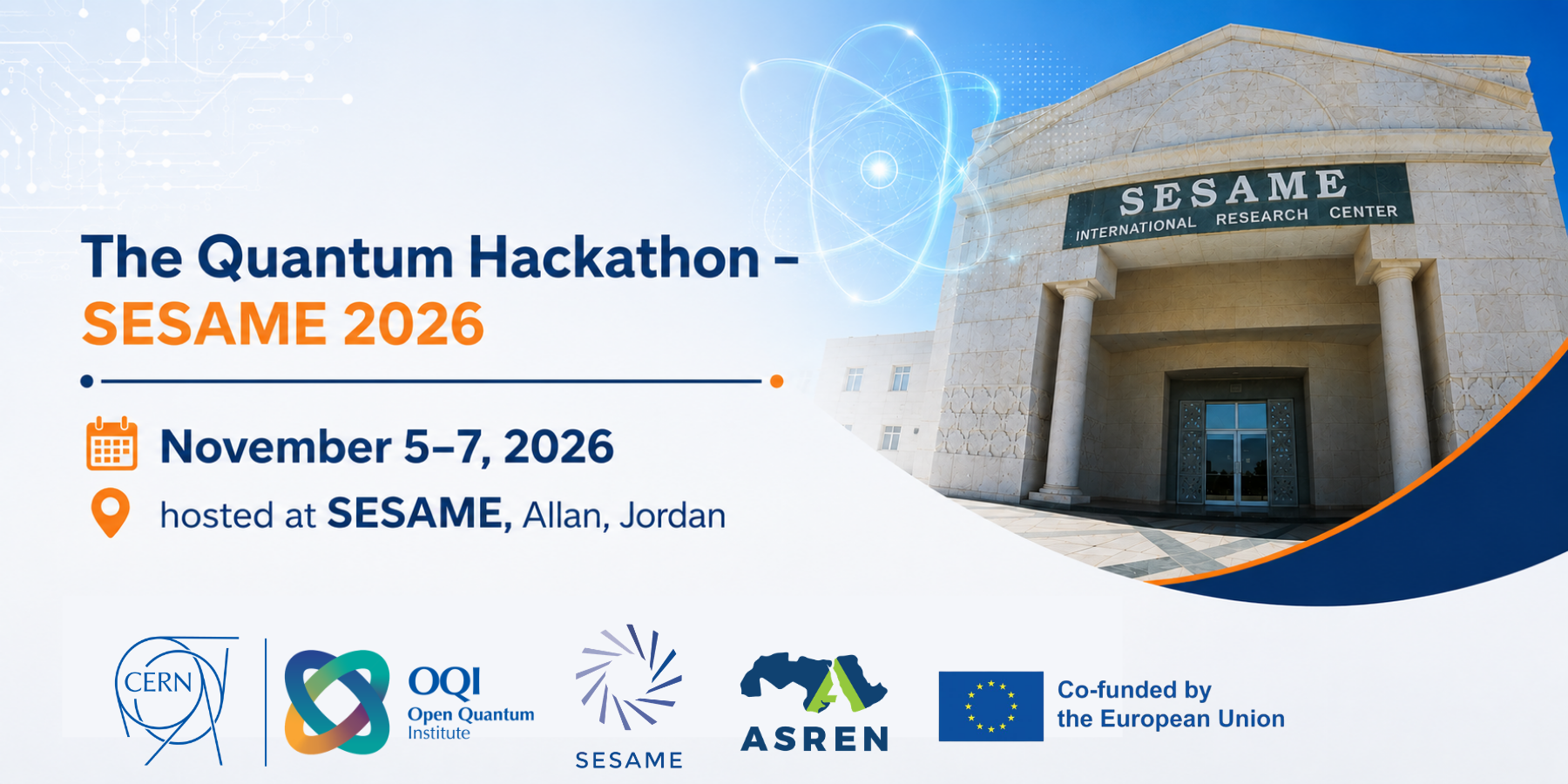
The Quantum Hackathon – SESAME 2026 focuses on the use of quantum computing to explore real-world problems related to water and energy.
Water scarcity, efficient use of water resources, energy management, renewable energy integration, and the growing connection between water and energy are important challenges in the Middle East. During the hackathon, participants will work in teams to investigate how quantum and hybrid quantum–classical computing approaches can be applied to selected problems in these areas.
The objective is not to assume that quantum computing will provide a better solution in every case, but to understand where quantum approaches may be useful, test them on realistic problem instances, and compare them with classical approaches where appropriate.
Challenge Structure
Each challenge will be based on a specific water or energy problem and will provide participants with a clear problem statement, objectives, constraints, and, where possible, a dataset or simplified problem instance.
Teams will be encouraged to:
- understand and formulate the water or energy problem,
- identify the main variables, objectives, and constraints,
- investigate suitable quantum or hybrid quantum–classical algorithms,
- implement and test a small-scale proof of concept,
- compare the approach with a classical solution or baseline where possible,
- clearly discuss the results, limitations, and potential for future development.
The focus is on hands-on problem solving and realistic experimentation, rather than purely theoretical work.
Thematic Areas
SDG 6 – Clean Water and Sanitation
SDG description
A detailed description will be provided later. Please check this page regularly for updates.
SDG 7 – Affordable and Clean Energy
SDG description
A detailed description will be provided later. Please check this page regularly for updates.
Expected Outcomes
At the end of the hackathon, each team is expected to present:
- a clear description of the water or energy problem being addressed,
- the mathematical or computational formulation of the problem,
- the quantum or hybrid quantum–classical approach investigated,
- a working prototype, simulation, or algorithmic proof of concept,
- a comparison with a classical approach where appropriate,
- the main results and observations,
- identified limitations and possible next steps.
The objective is to demonstrate a well-understood and technically sound approach, rather than simply showing the use of a quantum computing tool.
Evaluation will emphasize:
- Relevance: How well the project addresses the selected water or energy problem.
- Problem formulation: How clearly the real-world problem, objectives, and constraints are translated into a computational problem.
- Quantum approach: Whether the selected quantum or hybrid approach is appropriate for the problem.
- Implementation: The quality of the prototype, simulation, or proof of concept.
- Analysis: How well the team interprets its results and discusses the limitations of the approach.
- Potential impact: The possible value of the proposed approach if developed further.
- Presentation and teamwork: The clarity of the final presentation and the team's ability to explain its work.
Tools & Platforms
Participants will be encouraged to use widely accessible quantum computing platforms and frameworks, such as:
- Qiskit and IBM Quantum resources,
- hybrid quantum–classical workflows,
- classical simulators when appropriate.
No prior access to quantum hardware is required.